Why customers ghost you when they are ready to buy
A five-step blueprint for finding the one sentence they were waiting for, and putting it everywhere they can hear it.
Nobody ghosts a message that gave them something to hold.
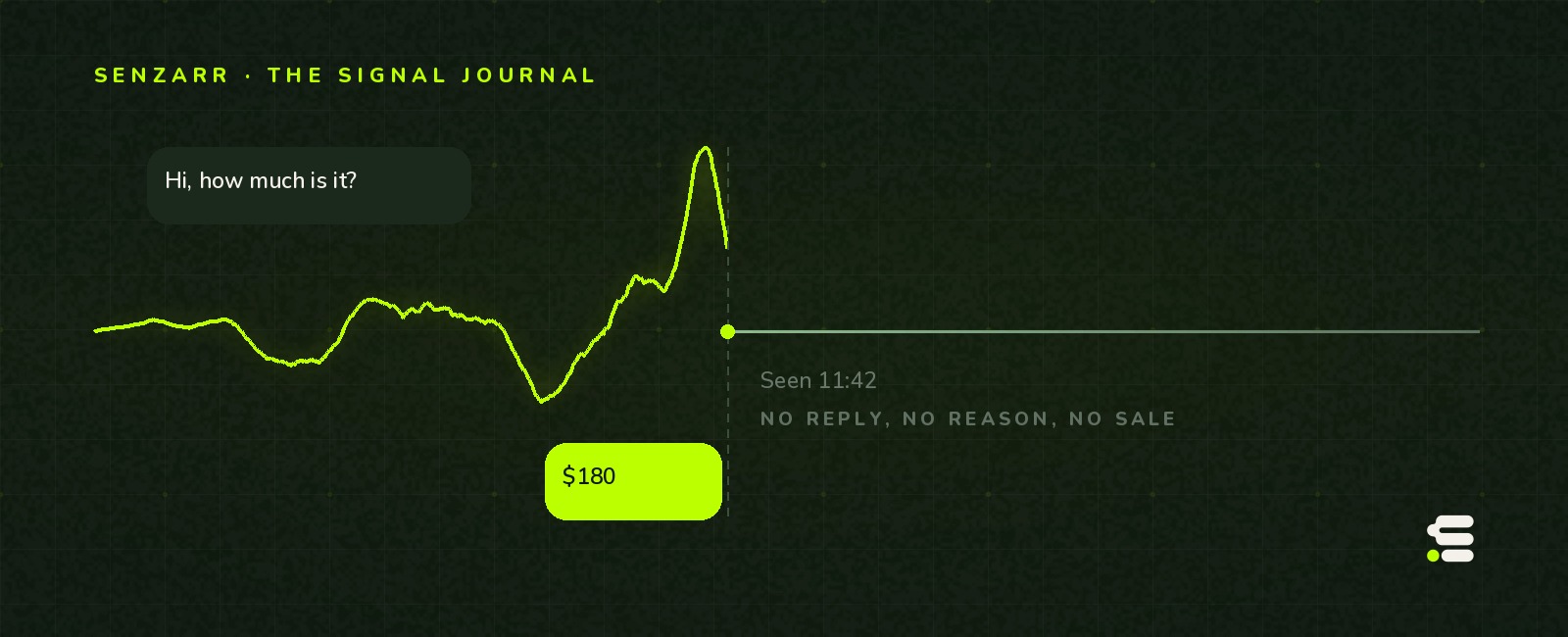
A customer asks your price.
You answer.
They say “okay, thank you.”
Then nothing.
Three days later the chat is still sitting there. Read. Unanswered. And somewhere between day two and day three you quietly decided they were never serious.
They were serious. They asked. People do not ask the price of things they do not want.
What happened in the gap between the question and the silence is the entire subject of this article. It is almost never the price, it is almost never the product, and it is almost always fixable in a single sentence.
This is a blueprint rather than an opinion piece. Five steps. You can run the first one tonight with nothing but your own phone.
Ghosting is feedback with the label torn off
A customer who goes quiet is not refusing you. Refusing takes effort. They would have to type something, and typing something means a small confrontation they get nothing out of.
So they do the frictionless thing instead. They close the app.
Which means silence is not a verdict on your product. It is a report on your message, delivered in the only format that costs them nothing. Once you read it that way, the question stops being why are people like this and becomes something you can actually work on: what did my message fail to give them?
They did not lose interest. They ran out of reasons to keep going.
In our own work this is the thing we are hired to find, and we have a name for it. We call it the signal: the one true sentence a business was never saying out loud. You can read how we go looking for it in our method, but you do not need us to start.
Step zero: the six places a sale actually goes quiet
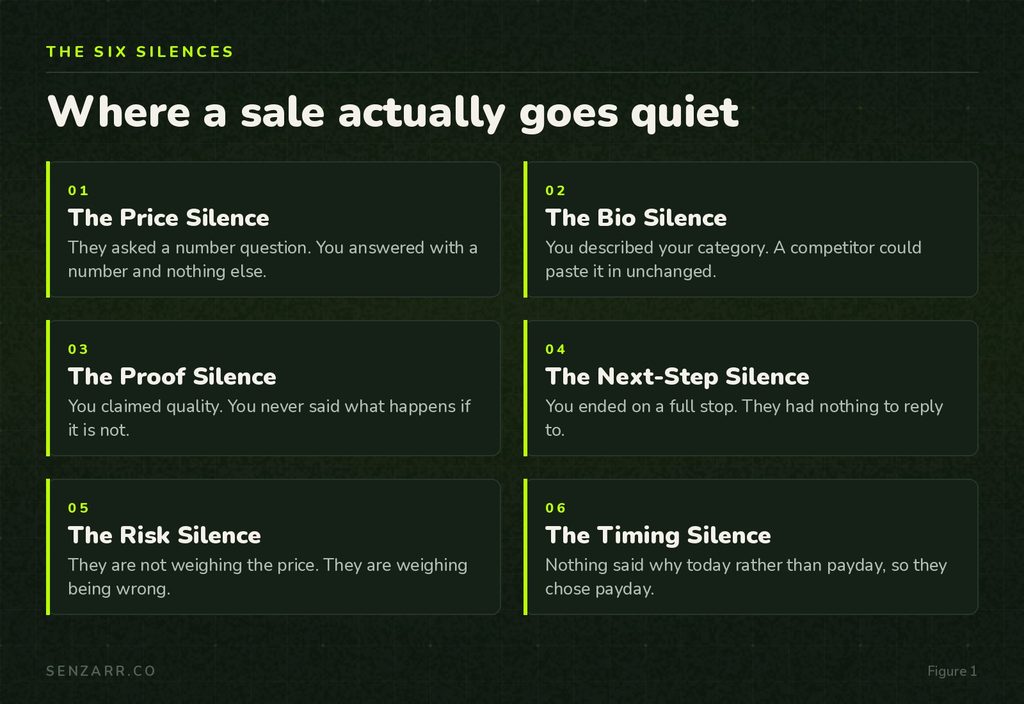
Before you rewrite anything, you need to know where the leak is. In almost every business we have audited, the silence starts in one of six places.
Read them again and be honest about which one is yours. Most owners know within about four seconds, and then spend the next four minutes explaining why theirs is different. It is not different.
The most common by a distance is the first one, so that is the one we will take apart.
Step one: look at what a ghosted reply actually looks like
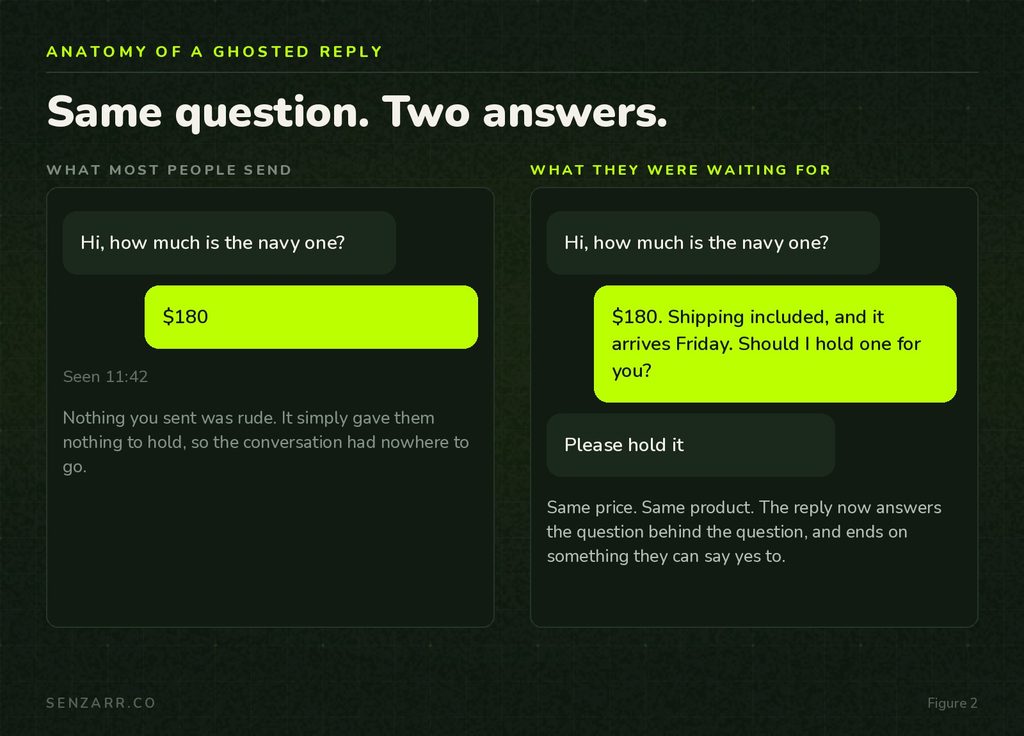
Here is an exchange that happens somewhere in your industry a few hundred times a day.
Look at what the customer was actually asking. On the surface it is “how much.” Underneath it is three questions stacked on top of each other, and they only voiced the easiest one.
Is that the real number, or does it grow at checkout?
When would I actually have it, and is that soon enough to matter?
What happens if I am wrong, and how exposed am I if this is a mistake?
A bare number answers one question out of three. The customer is left holding two, and since you did not raise them, they assume you would rather not. So they go away and think about it, which is the polite way of saying they close the app.
This is the whole mechanism. Not rudeness. Not price. An unanswered question they were never going to type out loud.
Step two: run the twenty-minute listening log
Now stop guessing, because you do not have to. You are sitting on more customer language than most agencies get access to in a month, and it is free.
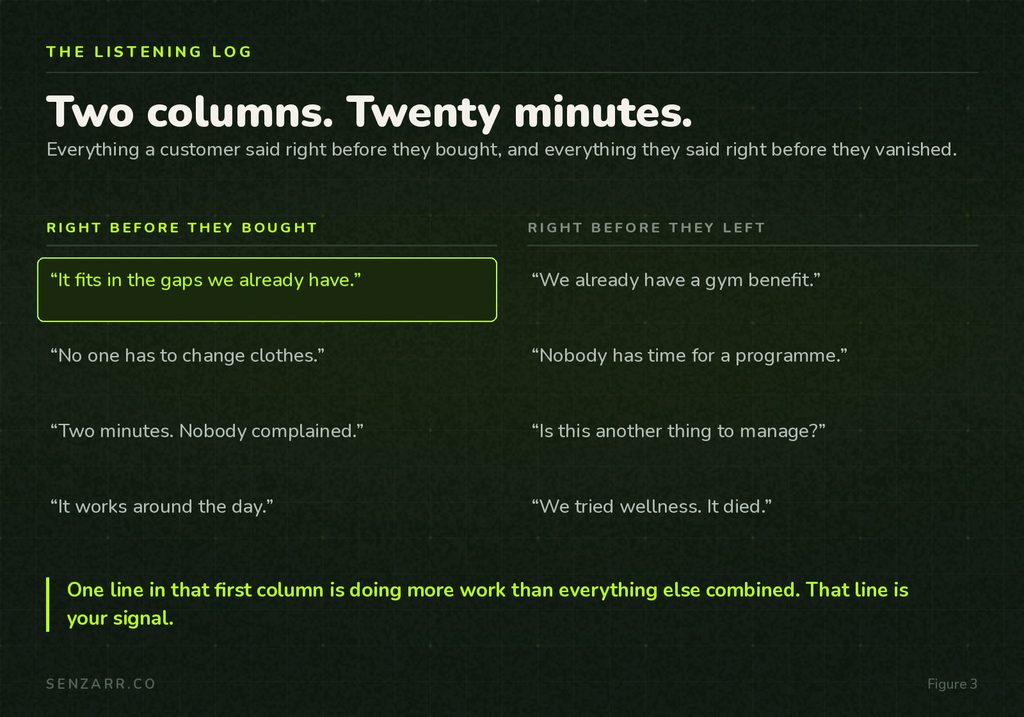
Open a blank page and draw one line down the middle. Then go through your own history and fill it in.
Open your messages, your email, your reviews. Go back ninety days, no further.
In the left column, write every sentence a customer said right before they bought. Their words, not your summary of their words.
In the right column, write every sentence they said right before they went quiet.
Do not edit, rank, or tidy. You are collecting, not deciding.
Stop at twenty minutes even if you are not finished. Twenty minutes is enough.
The rule that matters: these have to be their words. The moment you paraphrase, you have replaced their language with yours, and yours is the language that was not working.
Step three: find the line doing all the work
Now read the left column out loud. Somewhere in it is one sentence doing more work than everything else combined.
You will know it when you hit it, because it will be the one that makes you slightly uncomfortable. It is usually smaller than you want it to be. It is usually missing the words you are proudest of.
For one client of ours, a workplace wellness company, it was eight words from a facilities manager: movement that fits the day you already have. No mention of health, outcomes, or equipment. Just the thing their buyer was quietly solving for.
That sentence was not written in a workshop. It was already in their inbox, and had been for a year.
Three tests to confirm you have found it:
Could a competitor paste it onto their page unchanged? If yes, it is a category, not a signal. Keep looking.
Does it name the thing they are quietly afraid of? The real signal usually sits right next to a fear.
Would your customer recognise it as their own? Not admire it. Recognise it. Those are very different reactions and only one of them sells.
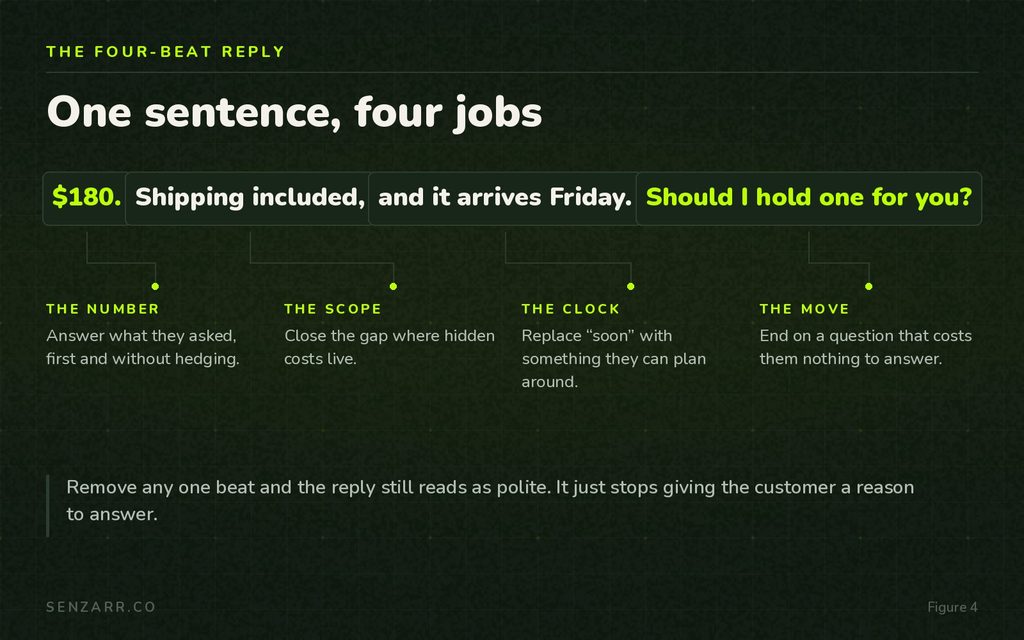
Step four: write the four-beat reply
Here is the format we use when a message has to answer the question behind the question. There is no acronym, because an acronym would be one more thing to remember and you have enough of those.
Four beats. In order.
The fourth beat is the one most people skip, and it is the one that decides whether you hear back. A sentence that ends in a full stop asks nothing of the reader. A sentence that ends in a small, cheap question gives them something to press.
Notice the size of the ask. Not “shall I invoice you.” Not “are you ready to proceed.” Just should I hold one for you, which costs them nothing, commits them to nothing, and is far easier to answer than to ignore.
Three more, in other people’s voices
A tailor. “£240, and that includes the first fitting. Four weeks from measurement to collection. Want me to pencil in a Saturday slot while there are still some left?”
A software tool. “$49 a month, cancel any time, no setup fee. Most teams are live the same afternoon. Want me to send the five-minute setup so you can judge it properly?”
A consultant. “$3,500 for the audit, fixed, and you get the findings whether or not we work together after. Two weeks start to finish. Should I send the two questions I’d need answered first?”
Same four beats every time. The voice changes, the structure does not.
Step five: put the same sentence everywhere they can hear it
This is where most businesses stop, and it is why most rewrites fail. One good reply is a good reply. It is not a fix.
Your customer does not meet you in one place. They meet you on the page, then in the inbox, then in a message at eleven at night. If your signal only lives in one of those, the other two are still quietly undoing it.
So take the sentence you found in step three and wire it into every surface in order of how often it is read:
The bio and the homepage headline. Highest traffic, least edited. Start here. We go deeper on this in positioning.
The offer block. Where your price lives, your scope, clock and move should live beside it. See offer design.
The first email they get. The one that is automated and has not been opened by you in a year.
The reply you send at eleven at night. Save the four-beat version as a keyboard shortcut. This one surface will out-earn the rest combined.
The ad. Last, not first. An ad carrying a signal you have not tested is just a faster way to spend money.
Same product. Same price. Same market. One sentence they finally recognise as their own.
What to send the ones who already went quiet
You almost certainly have a list of them sitting in your phone right now. They are not dead. They are unanswered.
Do not apologise for following up, do not ask if they saw your last message, and do not discount. All three tell the customer the problem was the price, and the problem was never the price.
If they went quiet after the number “No pressure either way. The navy one is the last in your size, and I can hold it until Friday without a deposit. Want me to?”
If they went quiet after a proposal “Happy to leave this with you. Before I close the file, is the hesitation the timing or the scope? Either is fine, I just do not want to guess.”
If they went quiet months ago “Not chasing. We changed how we price this since we last spoke and you were the first person I thought of. Worth two minutes?”
Every one of those gives the customer something easy to press and an honest reason to press it. That is the whole trick, and it is the same trick as the fourth beat.
The blueprint, on one page
Find your silence. Which of the six is yours? Pick one, not three.
Run the listening log. Twenty minutes, ninety days back, their words only.
Find the line doing all the work. Run it through the three tests.
Write the four-beat reply. Number, scope, clock, move. In that order.
Put it everywhere. Bio, homepage, offer, first email, late-night reply, then the ad.
If you do only step two, you will still be ahead of most of your competitors, because almost nobody reads their own inbox on purpose.
Want to Hack More about Why Your Customers Go Quiet?
We wrote The Silent Customer Report: twenty-one pages on the six silences, twenty rewrites you can copy tonight, and four scripts for the moment a customer stops replying. It is free, and it arrives in under a minute.